
Introduction
In 2026, parents evaluating boarding schools are increasingly attentive to discipline policies, including the increasingly controversial subject of corporal punishment. Although much of the public debate focuses on K-12 day schools, the boarding context raises unique issues because students live on campus and are under supervision around the clock. This update examines the current legal environment, trends among boarding schools, alternative disciplinary models and practical advice for families navigating the admissions process.
What Corporal Punishment Means Today
Corporal punishment refers to intentional physical force applied to a student for disciplinary purposes, including hitting, spanking, paddling or other forms of physical pain. While the practice was once widespread in U.S. schools, most institutions have moved away from it in recent decades. Currently, whether corporal punishment is permitted depends largely on state law and individual school policy. There is no federal law banning corporal punishment in public or private schools, leaving regulation to states.
Legal and Policy Landscape in 2026
As of late 2025 into 2026, corporal punishment in schools is increasingly rare but remains lawful in certain states, particularly in private institutions:
Public schools: Corporal punishment is banned in a growing majority of states. Most recent data indicate that 33 states and Washington, D.C. have prohibited the practice in public schools, though some statutes vary in language and enforcement.
Private schools: Except in a small number of jurisdictions — including Illinois, Iowa, Maryland, New Jersey and New York — corporal punishment for students in private settings may still be lawful under state law.
Federal legislative efforts: In 2025 the Protecting Our Students in Schools Act was introduced in Congress with the aim of banning corporal punishment in schools receiving federal funds and promoting alternative disciplinary supports, though it had not been enacted as of early 2026.
In practice, even in states where the law technically allows corporal punishment, most schools — especially boarding schools — avoid physical discipline in favor of modern behavior management models.
Boarding School Discipline in Practice
Unlike day schools, boarding schools operate 24/7 residential programs where discipline includes not only classroom expectations but dorm life, meals and weekend supervision. For this reason, effective discipline systems focus on consistency, transparency and developmental appropriateness.
Experts and boarding school leaders cite several trends:
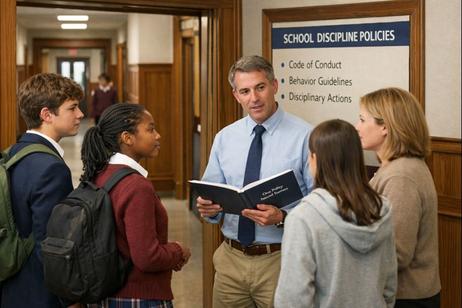
Clear, written discipline codes: Schools increasingly include discipline expectations, sanctions and appeals processes in handbooks provided at admission. Parents should request the latest version during the application process.
Parental consent and notification: In states where corporal punishment remains legal in some settings, policies often require written parental consent before physical discipline may be used, or explicit parental notification if it is part of the policy at all.
Training and alternative strategies: Boarding schools are moving toward positive behavioral interventions, restorative justice practices and trauma-informed approaches to address misconduct. These models aim to reduce exclusionary discipline and help students learn from mistakes without physical punishment.
Why Physical Discipline Has Declined
Multiple professional organizations and studies have highlighted concerns about corporal punishment’s effectiveness and harm. For example, longstanding statements from the American Academy of Pediatrics discourage corporal punishment, finding that it does not improve behaviour and may be associated with negative outcomes.
Although national data on corporal punishment frequency are dated, the available evidence suggests its use has fallen sharply over the past decade. Earlier reports found that only a small percentage of schools reported using corporal punishment and that the number of students physically punished annually had declined significantly compared with earlier years.
Equity and Civil Rights Considerations
Research dating back to the last decade consistently found disparities in how corporal punishment was applied, disproportionately impacting students of colour and students with disabilities. While public school reporting requirements provide some insight, there is no comprehensive federal reporting system for private schools. Parents should therefore ask how a boarding school monitors discipline equity and ensures that policies are fairly applied across all student groups.
Practical Guidance for Parents
For families considering boarding schools in the current academic cycle, discipline policy is a legitimate factor in decision-making. Here are key questions and planning tips:
-
Ask for the discipline policy early
Request a copy of the school’s current discipline handbook and clarification on whether corporal punishment is permitted or explicitly prohibited. If physical discipline appears in policy language, ask how often it is used and under what circumstances. -
Clarify parental rights and consent provisions
Ensure that you understand whether and how the school will notify or obtain consent before using certain disciplinary actions. Some schools have moved to policies that require explicit parental opt-in for any physical or restrictive disciplinary practices. -
Understand alternative disciplinary models
Boarding schools increasingly adopt restorative justice practices, peer mediation, behaviour contracts and counselling interventions. Ask admissions officers how these models are integrated into student life and how they support positive behaviour. -
Check how data are tracked and reviewed
Good boarding schools collect and review discipline data by demographics, such as gender, race and disability status, and adjust practices when disparities arise. This evidence-based approach helps prevent inequitable outcomes. -
Plan admissions timing around inquiries
Because boarding school admissions often begin more than a year before enrollment, families should raise discipline policy questions early in the fall or winter preceding applications to allow time for clarification and comparison across schools. -
Include discipline in your campus visit discussions
During on-campus visits or virtual Q&A sessions, include specific questions about discipline enforcement in dorms and classrooms, supervisor training, community culture and how behavioural expectations are communicated to students.
Boarding Schools and Positive Climate
Modern boarding schools emphasize community, student well-being and behavioural support systems that go beyond punishment. Many institutions now train staff in de-escalation techniques, social-emotional learning and restorative practices designed to uphold a safe living and learning environment. For more on overall boarding school culture and preparation, see our guide to What It Is Like at Boarding School: 2026 Guide for Parents & Students.
Conclusion
By 2026, corporal punishment is increasingly uncommon in U.S. boarding schools and is constrained by evolving state laws and professional standards emphasizing non-physical discipline. Legal permissibility varies, but a growing number of boarding schools explicitly prohibit physical discipline and adopt restorative methods to support student growth. Families should give discipline policies the same careful scrutiny they apply to academics, tuition and campus life when selecting a boarding school for their child’s education. Financing a Boarding School Education in 2025