Boarding Schools Leading in Climate & Environmental Education
Climate change is no longer a distant concept discussed only in science textbooks. It is a defining global issue shaping higher education, career pathways, and civic responsibility. As a result, boarding schools leading in climate and environmental education are redefining what a 21st century curriculum looks like.
In 2026, environmental literacy has evolved beyond elective coursework. The strongest programs now integrate climate science, sustainability practices, campus infrastructure, and community engagement into a unified educational model. For families seeking schools that align academic rigor with environmental responsibility, these institutions stand out.
Why Climate Education Matters in Boarding Schools
Boarding schools are uniquely positioned to lead in environmental education because students live on campus. Sustainability becomes more than theory. It becomes daily practice.
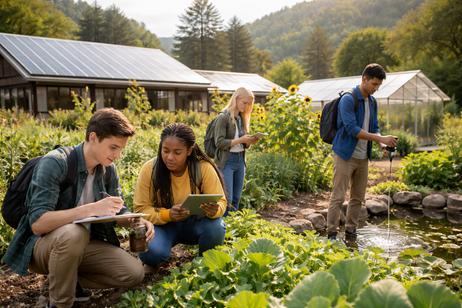
Students see renewable energy systems powering their dormitories. They participate in campus composting. They measure carbon footprints in math class. They conduct watershed studies on nearby land. Living laboratories create continuous, immersive learning.
National trends support this shift. The National Association of Independent Schools has highlighted sustainability and environmental responsibility as priority areas for innovation in independent education. Colleges are also expanding environmental studies programs, renewable energy research, and climate policy initiatives, reinforcing the importance of strong preparation at the secondary level.
For parents researching schools, environmental leadership increasingly joins academic strength and college placement as a key consideration. Families who are already exploring resources such as How to Choose a Boarding School are now adding sustainability commitments to their evaluation checklist.
What Defines a Leader in Climate & Environmental Education?
Not all environmental programs are created equal. Boarding schools leading in climate and environmental education share several distinguishing characteristics:
-
Integrated Curriculum
Climate science is embedded across disciplines, including:- Environmental chemistry
- Climate data modeling in mathematics
- Environmental literature and ethics
- Sustainable design in engineering courses
-
Campus as Classroom
Facilities reflect environmental commitments:- Solar arrays and renewable energy systems
- LEED certified buildings
- Sustainable forestry management
- Organic gardens and regenerative agriculture
-
Research & Fieldwork
Students conduct real-world research through:- Biodiversity surveys
- Watershed restoration projects
- Marine science field stations
- Climate policy simulations
-
Measurable Sustainability Goals
Leading schools publish carbon reduction targets, waste diversion data, and energy benchmarks, aligning with frameworks such as the U.S. Green Building Council standards.
Schools Setting the Standard in 2026
Several institutions have become widely recognized for their comprehensive environmental leadership.
The Thacher School, California
Situated in Ojai, The Thacher School integrates environmental stewardship with its long-standing outdoor education traditions. The school’s solar installations and water conservation systems are embedded into science curricula, while students manage campus gardens and land stewardship initiatives.
In 2026, Thacher expanded its renewable energy capacity, aiming to further reduce grid dependency. Faculty report that environmental literacy is no longer confined to science departments; humanities courses now include climate ethics and sustainability policy analysis.
Choate Rosemary Hall, Connecticut
Choate Rosemary Hall continues to strengthen its environmental initiatives through its Kohler Environmental Center. The campus includes high-performance green buildings, student-managed gardens, and advanced sustainability research programs.
The school’s commitment to reducing emissions aligns with global climate goals outlined by the Intergovernmental Panel on Climate Change. In 2026, Choate announced updated emissions tracking systems and student-led sustainability audits.
Vermont Academy, Vermont
Vermont Academy leverages its rural setting to offer immersive ecological education. Students participate in forest management studies, local watershed projects, and regional climate resilience research.
In recent years, the school has expanded its experiential learning programs, integrating climate fieldwork with college preparatory science tracks. Students pursuing environmental majors benefit from applied research experience before graduation.
Phillips Exeter Academy, New Hampshire
Phillips Exeter Academy has committed to long-term carbon reduction strategies, investing in geothermal heating systems and renewable energy installations. Environmental studies courses emphasize interdisciplinary analysis, blending economics, ethics, and science.
The school also partners with local and regional environmental organizations to provide internship opportunities for upperclassmen.
2026 Trends in Green Boarding Initiatives
Environmental education continues to evolve rapidly. Several 2026 developments stand out among boarding schools leading in climate and environmental education.
Carbon Neutrality Commitments
More schools are setting formal carbon neutrality timelines. While full neutrality remains ambitious, incremental reductions are measurable. Schools now publish sustainability dashboards tracking:
* Energy consumption
* Waste diversion rates
* Water usage
* Scope 1 and Scope 2 emissions
These transparency measures align with growing expectations from families and accrediting bodies.
Climate Entrepreneurship Programs
A growing number of boarding schools are introducing climate entrepreneurship tracks. Students design:
* Sustainable product prototypes
* Carbon offset business models
* Renewable energy feasibility studies
These programs connect environmental science with business innovation, preparing students for emerging green economy careers.
Climate Justice & Policy Integration
In 2026, environmental education increasingly incorporates social impact. Courses explore:
* Climate migration
* Environmental justice
* Global food security
* Policy advocacy
Students participate in model climate negotiations and collaborate with local governments on resilience planning.
Sustainable Dining & Agriculture
Dining services have become key sustainability platforms. Schools are:
* Sourcing locally grown produce
* Expanding plant-forward menus
* Operating compost-to-garden systems
* Tracking food waste reduction
Some campuses now operate regenerative agriculture programs that feed directly into student dining halls, reinforcing closed-loop sustainability systems.
How Boarding Schools Compare
Below is a simplified comparison framework families can use when evaluating boarding schools leading in climate and environmental education:
| Feature | Emerging Programs | Established Leaders |
|---|---|---|
| Dedicated Environmental Center | Limited | Yes |
| Renewable Energy Infrastructure | Partial | Extensive |
| Published Sustainability Metrics | In progress | Annual reporting |
| Interdisciplinary Climate Courses | Select electives | Integrated curriculum |
| Field Research Opportunities | Occasional | Ongoing partnerships |
Families can combine this analysis with guidance found in Questions to Ask When Touring a Boarding School to ensure sustainability claims translate into meaningful educational outcomes.
What Colleges Look For
Colleges increasingly value applicants who demonstrate sustained engagement in environmental initiatives. Students graduating from boarding schools with strong climate programs often present: * Independent environmental research * Community-based sustainability leadership * Published data analysis projects * Internships with environmental organizations
These experiences align well with competitive environmental science, engineering, and policy programs.
Families concerned about college outcomes can explore how environmental specialization fits into broader admissions strategy in How Boarding Schools Prepare Students for Top Colleges.
Evaluating Authentic Commitment
Marketing language around sustainability has increased across the education sector. However, discerning families should look for measurable commitments.
Key questions include: * Does the school publish annual sustainability data? * Are students involved in decision-making? * Are facilities upgrades ongoing or one-time projects? * Is climate education integrated across departments?
Authentic leadership in climate and environmental education requires long-term institutional alignment, not isolated initiatives.
The Broader Educational Impact
Boarding schools leading in climate and environmental education are shaping students who understand systems thinking. Graduates learn to connect scientific data, public policy, economics, and ethics.
In 2026, environmental literacy is no longer a niche interest. It is foundational civic knowledge. Schools that embrace this reality are preparing students not only for college, but for leadership in a changing world.
For families evaluating boarding options, sustainability programs should be viewed alongside academic rigor, faculty expertise, and community culture. The most successful institutions integrate all three seamlessly.
Final Thoughts
Climate and environmental education has moved to the center of innovation in independent schooling. Boarding schools that treat sustainability as a living, measurable commitment, rather than a marketing slogan, stand apart.
As environmental challenges intensify globally, students educated in campuses that model responsible stewardship gain a distinctive advantage. They graduate with not only knowledge, but practical experience, ethical grounding, and a forward-looking mindset.
For parents exploring boarding schools in 2026, examining climate leadership is no longer optional. It is essential.