
Boarding Schools Leading in Climate & Environmental Education
Climate change and environmental sustainability have moved from peripheral topics to core priorities in education. For many families considering boarding school, a school’s commitment to environmental education is no longer a bonus, it is a deciding factor. In 2026, leading boarding schools are responding with ambitious climate curricula, carbon reduction strategies, and campus-wide sustainability initiatives that extend well beyond recycling programs.
These schools are preparing students not only to understand climate science, but also to lead responsibly in a world shaped by environmental challenges. From carbon-neutral campuses to climate justice coursework, boarding schools are uniquely positioned to model environmental stewardship while integrating it into daily residential life.
This updated overview highlights how boarding schools are leading in climate and environmental education, with recent initiatives, expert perspectives, and practical examples for families evaluating schools with strong sustainability values.
Why Boarding Schools Are Well Positioned for Climate Leadership
Boarding schools function as small, self-contained communities. Students live, learn, eat, and participate in activities on campus, making sustainability practices highly visible and immediately impactful.
Key advantages include:
- Centralized energy, food, and waste systems that can be redesigned sustainably
- Residential life that reinforces daily environmental habits
- Flexible curricula that support interdisciplinary climate education
- Long-term campus planning aligned with environmental goals
Unlike day schools, boarding schools can integrate climate education into both academics and daily living, creating a culture where sustainability is practiced, not just taught.
Curriculum Innovations in Environmental and Climate Education
In 2026, climate education at leading boarding schools is increasingly interdisciplinary. Environmental studies programs now blend science, economics, ethics, policy, and global studies.
Common academic features include:
- Climate science integrated into biology, chemistry, and physics
- Environmental ethics and climate justice within humanities courses
- Project-based learning focused on local and global sustainability challenges
- Capstone projects addressing real-world environmental problems
Some schools have introduced climate literacy graduation requirements, ensuring all students develop a foundational understanding of climate systems and solutions.
Advanced offerings often include partnerships with universities and research institutions, allowing students to participate in data analysis, field research, and climate modeling.
Experiential Learning Beyond the Classroom
Experiential learning is a defining feature of environmental education at boarding schools. Hands-on programs help students connect theory with action.
Examples include:
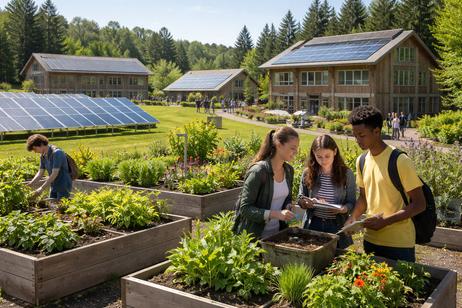
- Student-managed organic farms and gardens
- Renewable energy monitoring of campus solar or wind systems
- Watershed and biodiversity research on school-owned land
- Outdoor education programs emphasizing conservation and ecology
These experiences reinforce environmental responsibility while developing leadership and problem-solving skills. They also align with the experiential focus seen in postsecondary education, as discussed in community college environmental programs.
Sustainable Campus Operations and Infrastructure
Boarding schools leading in climate and environmental education increasingly view their campuses as living laboratories. Sustainability goals influence building design, energy use, food sourcing, and transportation.
Green Buildings and Energy Use
Many schools now pursue LEED-certified construction and major energy upgrades, guided by standards from the U.S. Green Building Council. Solar arrays, geothermal heating, and energy-efficient retrofits are becoming standard features.
Participation in programs like the EPA Green Power Partnership helps schools benchmark renewable energy usage and demonstrate accountability.
Food Systems and Waste Reduction
Dining services are another area of innovation. Schools are investing in:
- Farm-to-table dining partnerships
- On-campus composting programs
- Reduced food waste through data tracking
- Plant-forward menu options
These efforts connect sustainability with student health and global food security.
Climate Action Commitments and Accountability
An increasing number of boarding schools have adopted formal climate action plans. Many align with frameworks established by organizations such as Second Nature, which supports climate commitments across educational institutions.
These plans often include:
- Carbon neutrality targets
- Transparent emissions reporting
- Student-led sustainability councils
- Regular progress updates to families and alumni
Accountability matters to parents evaluating whether sustainability claims translate into measurable action.
Faculty Expertise and Institutional Leadership
Strong environmental education depends on faculty leadership. Boarding schools are recruiting educators with advanced training in environmental science, policy, and sustainability education.
Professional development partnerships with organizations such as the Association for the Advancement of Sustainability in Higher Education help faculty stay current with best practices and research.
Institutional leadership also plays a role. Head of school support is often the difference between isolated green initiatives and a comprehensive sustainability strategy embedded across academics and operations.
Preparing Students for Environmental Careers
Boarding schools leading in climate education increasingly frame sustainability as a career pathway. College counseling offices highlight environmental majors, internships, and research opportunities.
Students interested in environmental careers often pursue:
- Environmental science and engineering
- Sustainability and climate policy
- Renewable energy and green technology
- Environmental law and advocacy
This preparation aligns with trends seen at the postsecondary level, where sustainability-focused pathways are expanding at two-year institutions as well, as outlined in community college sustainability pathways.
Equity, Climate Justice, and Global Citizenship
Environmental education in 2026 extends beyond science to address equity and global impact. Many boarding schools incorporate climate justice into their curricula, examining how climate change disproportionately affects vulnerable populations.
Programs may include:
- Global partnerships with schools in climate-impacted regions
- Service learning focused on environmental justice
- Cross-cultural dialogue on sustainability solutions
This approach reflects a broader educational trend toward socially responsible leadership, connecting environmental stewardship with ethical decision-making.
How Parents Can Evaluate Environmental Commitment
Families assessing boarding schools should look beyond marketing language. Meaningful indicators of climate leadership include:
- Published sustainability or climate action plans
- Dedicated environmental studies departments or centers
- Student involvement in sustainability governance
- Measurable outcomes such as energy reduction or waste diversion
Parents may also wish to compare boarding school sustainability practices with those found at other institutions, including community colleges known for applied environmental training, as discussed in career-focused environmental education.
The Future of Climate Education at Boarding Schools
As climate challenges intensify, boarding schools are likely to play an even larger role in shaping environmentally literate leaders. The residential model allows schools to integrate sustainability into every aspect of student life, creating habits and values that extend far beyond graduation.
In 2026, boarding schools leading in climate and environmental education are not only responding to global urgency, they are setting standards for how educational institutions can operate responsibly, educate holistically, and inspire action.
For families seeking schools that combine academic rigor with environmental responsibility, these institutions represent a powerful model of education aligned with the needs of the future.