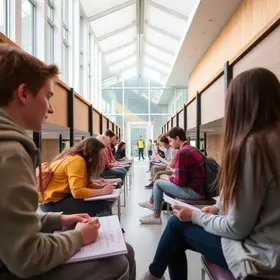

A gleaming science laboratory can make a powerful impression during a boarding school visit. Sophisticated microscopes, robotics equipment, 3D printers, and dedicated research spaces suggest academic ambition and investment in modern education. However, impressive facilities do not automatically translate into meaningful learning experiences for every student.
For families comparing boarding schools in 2026, the challenge is distinguishing between attractive facilities and programs that genuinely develop scientific curiosity, technical skills, and independent thinking. A school may showcase expensive equipment while offering limited student access, or it may operate modest laboratories where students conduct sophisticated investigations under experienced teachers.
Understanding how to evaluate boarding school science labs, makerspaces, and research facilities requires looking beyond architecture and technology. Parents should investigate who uses these spaces, how frequently students participate, what they accomplish, and whether opportunities match their child's interests and abilities.
Look Beyond the Equipment to Understand Student Learning
Modern science education involves more than following laboratory instructions or observing demonstrations. Students should have opportunities to formulate questions, design investigations, analyze evidence, and explain their conclusions.
The National Academies of Sciences, Engineering, and Medicine emphasizes integrating scientific and engineering practices with disciplinary knowledge and concepts that connect different scientific fields. Its framework highlights investigation, modeling, data analysis, and evidence-based reasoning as essential components of science education.
During a laboratory tour, ask teachers to describe a typical student experiment. Does the teacher determine every step, or can students make decisions about methodology and interpretation? Are students encouraged to investigate unexpected results?
A well-equipped laboratory becomes educationally valuable when students use its resources to explore meaningful questions rather than simply complete predetermined exercises.
Families examining broader academic expectations can also consult Boarding School Review's article on what is being taught, which explains the importance of evaluating teaching methods alongside curriculum offerings.
Determine Who Actually Uses the Science Facilities
One of the most important questions during a campus visit is deceptively simple: Which students can use this equipment?
Some boarding schools reserve specialized instruments for advanced courses, independent research, or competitive academic teams. Other schools incorporate laboratory activities throughout their science curriculum.
Neither arrangement is necessarily inappropriate. However, families should understand the difference before assuming that every student benefits equally from the facilities being advertised.
Ask whether introductory biology, chemistry, and physics students regularly conduct experiments. Find out whether younger students can participate in makerspace activities and whether advanced research opportunities require prerequisites, faculty recommendations, or competitive selection.
Parents should also investigate how often laboratories operate during an ordinary school week. A facility that hosts daily instruction offers a different experience from one used primarily for occasional demonstrations.
The goal is to determine whether access is routine, selective, or largely promotional.
Evaluate Makerspaces Through Student Projects
Makerspaces often contain some of the most visually impressive equipment on a boarding school campus. Laser cutters, electronics stations, robotics kits, fabrication tools, and computer-controlled machines can suggest limitless creative possibilities.
However, equipment alone does not establish the quality of an engineering or design program.
Ask to see projects completed by students at different grade levels. Look for evidence of planning, experimentation, revision, and problem-solving rather than only polished final products.
The National Academies of Sciences, Engineering, and Medicine describes effective science and engineering instruction as a process involving student investigation, teacher guidance, evidence gathering, and repeated refinement of solutions.
A strong makerspace program should allow students to encounter setbacks, reconsider designs, and improve their work. These experiences can be more educationally valuable than assembling a sophisticated device from detailed instructions.
Parents should also ask whether makerspace participation is integrated into academic courses or offered exclusively through extracurricular clubs. Students with demanding athletic or residential schedules may have difficulty participating if access is limited to a narrow afternoon activity period.
Investigate Research Opportunities and Faculty Mentorship
Research facilities deserve particular attention when a student already has a strong interest in biology, chemistry, physics, environmental science, or engineering.
Some boarding schools offer independent investigations, faculty-supervised projects, or partnerships with universities and research organizations. However, the existence of these opportunities does not guarantee that students can participate.
Families should ask how research projects begin, who supervises them, and what academic preparation is required. They should also determine whether students receive scheduled research time or must complete their projects independently around other obligations.
Boarding School Review's discussion of independent study and research opportunities at boarding schools provides additional context about mentorship, capstone projects, and the challenges of sustained academic investigation.
Faculty expertise matters as much as specialized equipment. An experienced science teacher who helps students develop realistic research questions, interpret results, and overcome technical difficulties may contribute more to student learning than a sophisticated laboratory without consistent guidance.
Ask whether recent student projects resulted in research presentations, scientific reports, exhibitions, or continued investigations. Concrete examples help establish whether research is a functioning academic opportunity rather than an aspirational program description.
Examine Laboratory Safety and Supervision
Safety is an essential part of evaluating science laboratories and makerspaces. Students should receive appropriate training before handling chemicals, operating machinery, or using potentially hazardous equipment.
The American Chemical Society recommends systematic laboratory safety practices, including hazard recognition, risk assessment, preventive measures, and emergency preparation. These principles provide a useful framework for examining school procedures.
During a tour, observe whether protective equipment is available, workspaces are organized, and safety instructions are clearly displayed. Ask how students are trained before using specialized machinery and whether adult supervision is required.
Families should also determine who maintains equipment, monitors chemical storage, and responds to laboratory incidents. An impressive facility should be supported by equally strong safety procedures.
Consider Whether Facilities Are Accessible Outside Class
Boarding schools have a distinctive advantage because students live on campus. In principle, this arrangement can support extended academic projects, evening collaboration, and extracurricular experimentation.
However, residential access should never be assumed.
Ask whether students can use makerspaces after classes, during designated evening periods, or on weekends. Determine whether faculty supervision, reservations, or special permissions are required.
These details matter particularly for students balancing advanced coursework with athletics, performing arts, and residential responsibilities.
Families can explore related scheduling considerations in Boarding School Review's article on boarding school academic schedule flexibility.
A laboratory that is technically available but rarely accessible may provide fewer opportunities than a smaller facility with predictable supervised hours.
Ask Students About Their Actual Experiences
Current students can provide valuable perspectives that differ from formal admissions presentations.
Rather than asking whether they enjoy the science facilities, invite them to describe their most recent laboratory experiment or engineering project.
Find out whether students regularly design investigations, collaborate with classmates, and receive constructive feedback from teachers.
The American Chemical Society emphasizes laboratory experiences that include preparation, hands-on investigation, and reflection. These stages help students connect scientific concepts with practical experimentation.
Student conversations can reveal whether this kind of learning occurs consistently.
Parents should also ask what happens when experiments fail, or projects require additional time. A supportive academic environment should treat setbacks as opportunities for investigation rather than simply unsuccessful assignments.
Compare Educational Value Rather Than Facility Size
Families should resist assuming that the newest or largest science building automatically offers the strongest education.
A smaller boarding school may provide frequent laboratory access, personalized mentorship, and substantial student responsibility. A larger institution may offer specialized equipment, extensive course selections, and more advanced research infrastructure.
The better choice depends on how effectively each school connects its resources to the student's academic interests.
When comparing facilities, consider four practical factors: frequency of student use, quality of faculty guidance, opportunities for independent investigation, and accessibility across grade levels.
These measures provide a more meaningful basis for comparison than construction costs, equipment inventories, or architectural design.
Conclusion: Focus on What Students Actually Do
Evaluating boarding school science labs, makerspaces, and research facilities requires careful attention to everyday academic experiences rather than impressive campus presentations.
The most revealing evidence comes from student projects, laboratory schedules, faculty conversations, and clear explanations of how students gain access to specialized resources.
Families should leave each campus understanding not simply what equipment the school owns, but what their child could realistically accomplish with it.
Ultimately, the strongest science facilities are those that encourage curiosity, develop practical skills, support thoughtful experimentation, and help students become increasingly independent learners. A modest laboratory that consistently delivers these experiences may be more valuable than an extraordinary facility that students rarely use.